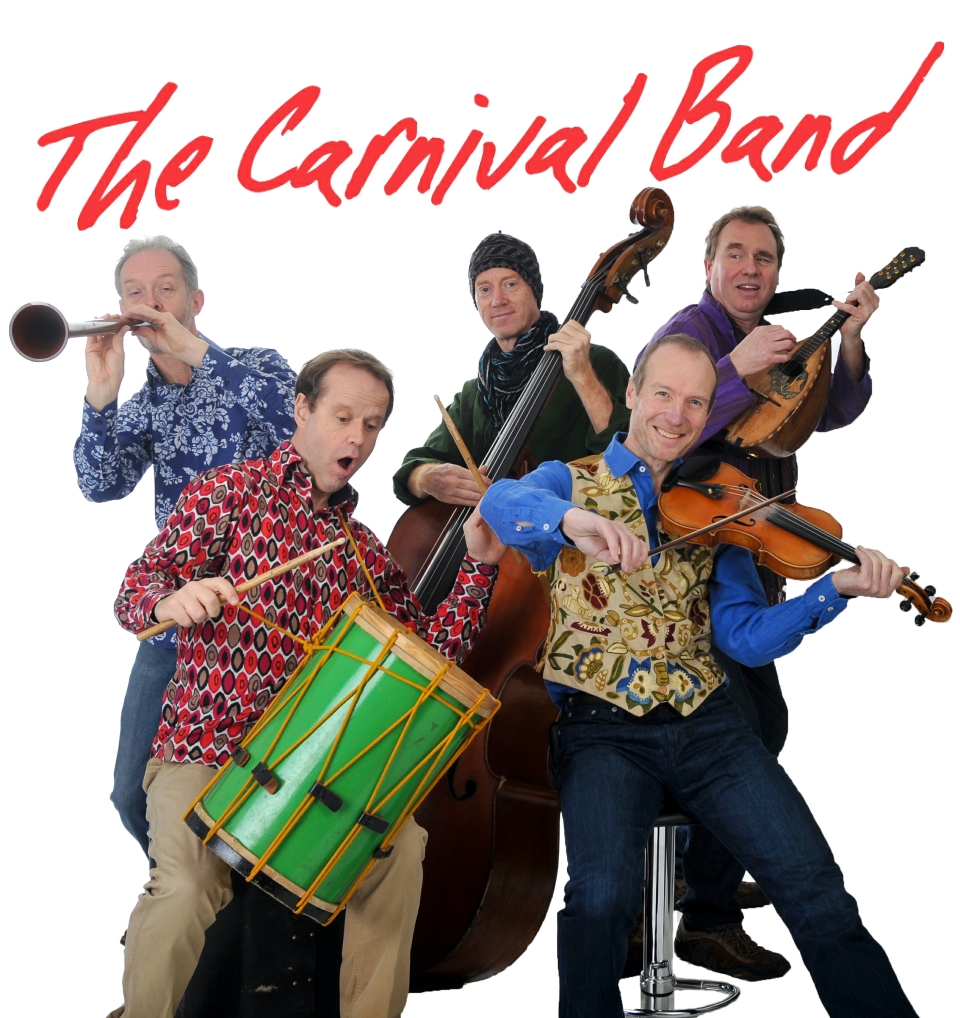
Andy Watts Giles Lewin Steno Vitale Steve Banks 'Jub' Davies

Instruments

Clarinet 
Andy writes: Possibly the most versatile of wind instruments, at home in jazz, classical, klezmer and practically any style you care to name, the clarinet is truly a world instrument. I've got a little bamboo clarinet that I bought on the streets of Calcutta, and I first heard the amazing sound of the Turkish clarinet in a bar in Istanbul. My 'normal' clarinet is in C, a tone higher than the more usual Bb, with a brighter sound. The Turkish clarinet is a fourth lower in G and made of metal.

Played by: Andy

Made by: Noblet, Paris c.1970 (C clarinet); Anonymous, Istanbul c.1990 (Turkish clarinet)

Favourite track: Banjski Kocek from Hoi Polloi

Shawm 
Andy writes: Shenai, zurna, shawm, piffaro, bombard - many musical cultures throughout the world use a version of this raucous double-reed woodwind instrument for festivals, celebrations and street music. I play either in a fairly 'straight' ceremonial style associated with renaissance wind band music or in a style loosely based on recordings of Italian piffaro players with slides, grace notes and bent notes. Either way, I love the instrument's carnival blare. From time to time I persuade Giles to join me to create a 'horn section' or a classic shawm and bagpipe combo.

Played by: Andy, Giles

Made by: A Eric Moulder, England c. 1980 (renaissance and folk shawms in C and D); Camac, France c. 1985 (Breton Bombarde)

Favourite track: Madame Lucette from Jump for Joy!

Bagpipes 
Andy writes: Look at the paintings of 16th century peasant life by Brueghel and his contemporaries, and among the revellers you'll often see a bagpiper looking longingly at the wedding feast or with jug of ale near at hand! Jon Swayne's superb pipes, based closely on these pictures have a rich sonorous tone, not especially loud, so they sit well with the rest of the band. As with all drone instruments, the feeling of tension and resolution as the chanter notes move around the constant tonal centre is magical - maybe even mystical. Thanks Jon!

Played by: Andy, Giles

Made by: Jonathan Swayne, England c. 1980 (Flemish bagpipes in D)

Favourite track: Bransle de Poictou from Hoi Polloi

Djembe 
Steve writes: The djembe is the hour-glass shaped hand drum that is most common in the countries in the West of Africa (e.g. Gambia, Senegal, Ghana, Burkina Faso). It has become very popular in the UK, with festivals dedicated to drumming (e.g. "Tribe of Doris"!).

It has three main notes: a bass note made by hitting the middle of the drum, a high note at the edge of the drum, and the `slap', a sharp high note made with a whipping action towards the edge of the drum. You have to go through a rite of passage in learning to play the slap note - the hand has to learn how not to hit the drum - through painful bruising! The rhythms of traditional West African music are fantastic, made for dancing, and can be very complex. In true Carnival Band form I sometimes use the djembe a bit out of its usual context, such as in Dracevka on Hoi Poloi (there isn't much African music in 7 time!).

Made by: "Pams", from the Gambia. His girlfriend sold it to me at a class I was teaching in Covent Garden. I met him when I went out to Gambia. He had a finger missing from tuning his djembe. Still played pretty fast and furious though.

Played by: Steve

Made by: "Pams", from the Gambia

Favourite track: San Remo from Hoi Polloi